Constat
- Quebec has 1,091 municipalities for approximately 9 million inhabitants; Ontario has 444 for 16 million.
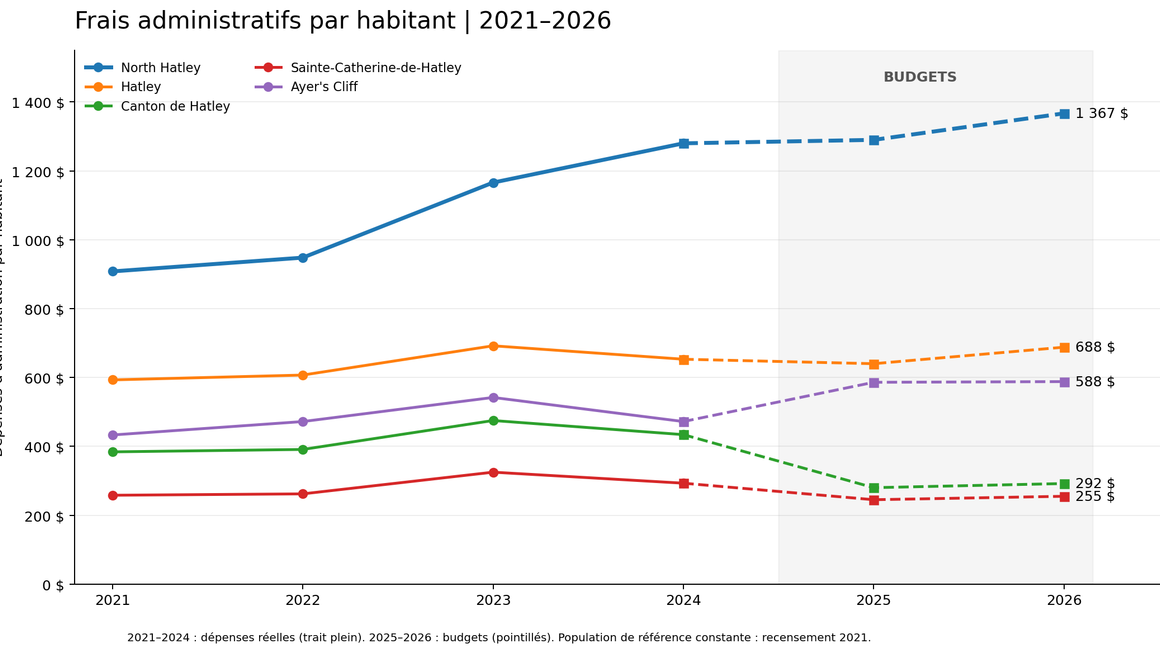
- Nearly 700 municipalities have 2,000 residents or fewer. Like North Hatley (~700 residents), these organizations manage tight budgets, small teams, costly infrastructure, and growing demand for services.
Why ask the question?
Rising costs and administrative duplication (town hall, council, management, systems) undermine efficiency. In addition, all municipalities need an accountant, a lawyer, and an inspector. There are many advantages to collaborating and sharing all these resources. Hence the interest in groupings and, in some cases, mergers of municipalities.
Consolidation ≠ Merger
Consolidation (intermunicipal cooperation)
Sharing resources and services (e.g., public works, recreation, IT) while retaining each municipal council.
Advantages: flexible and rapid implementation, targeted savings, preservation of local identity.
Points to note: avoid the “two-way effect” by clearly defining roles, cost allocation, and arbitration mechanisms.
Merger (complete unification)
Consolidation into a single municipality (one council, one administration).
Advantages: clear streamlining, elimination of duplication, unified strategic vision.
Points to consider: more politically challenging process, identity sensitivities, more difficult transition.
Focus on governance
The MAMH encourages the strengthening of municipal governance and supports cooperation agreements and, where relevant, groupings/mergers, including during the transition period.
How do you go about doing this, in practical terms?
- Diagnose: inventory of services, costs, assets/infrastructure, workforce, systems, projections (5–10 years).
- Set objectives: expected savings, service levels, priority investments, resilience.
- Choisir le véhicule :
- Service agreements, intermunicipal boards, shared services via the MRC (regional council),
- Merger (complete unification).
- Lock in governance: who decides what, accountability, cost sharing, arbitration clause.
- Consult: elected officials, employees, citizens, partners; document benefits and impacts.
- Formalize: matching resolutions, written agreements, transition schedule, communication plan.
Exemple local
In the short term, pooling services appears to be a winning strategy: e.g., road maintenance, emergency services, sharing of specialized employees—without merging.
Memories of the mergers of the 2000s make this a sensitive subject, but that does not prevent well-structured cooperation from being profitable for geographically close municipalities.
Inter-municipal recreation agreement
The intermunicipal recreation agreement (Township ↔ North Hatley) illustrates these gains. Has it been signed? This is typically the kind of agreement that reduces costs while maintaining service.
In summary
- There is costly duplication in many small municipalities, including North Hatley and the Township of Hatley.
- Mergers are not a panacea, but they do eliminate duplication.
- Consolidations offer a pragmatic and rapid solution if governance is clear. The risk of failure remains high.
- The right choice (consolidation or merger) depends on local objectives and the organizational capacity of the municipalities.
Should we consider merging the Township of Hatley with North Hatley?
Sure, let’s think about it.
Reference :
https://ici.radio-canada.ca/nouvelle/2196367/municipalites-fusions-quebec-nombre
https://ici.radio-canada.ca/nouvelle/2194730/retour-fusions-municipales-quebec