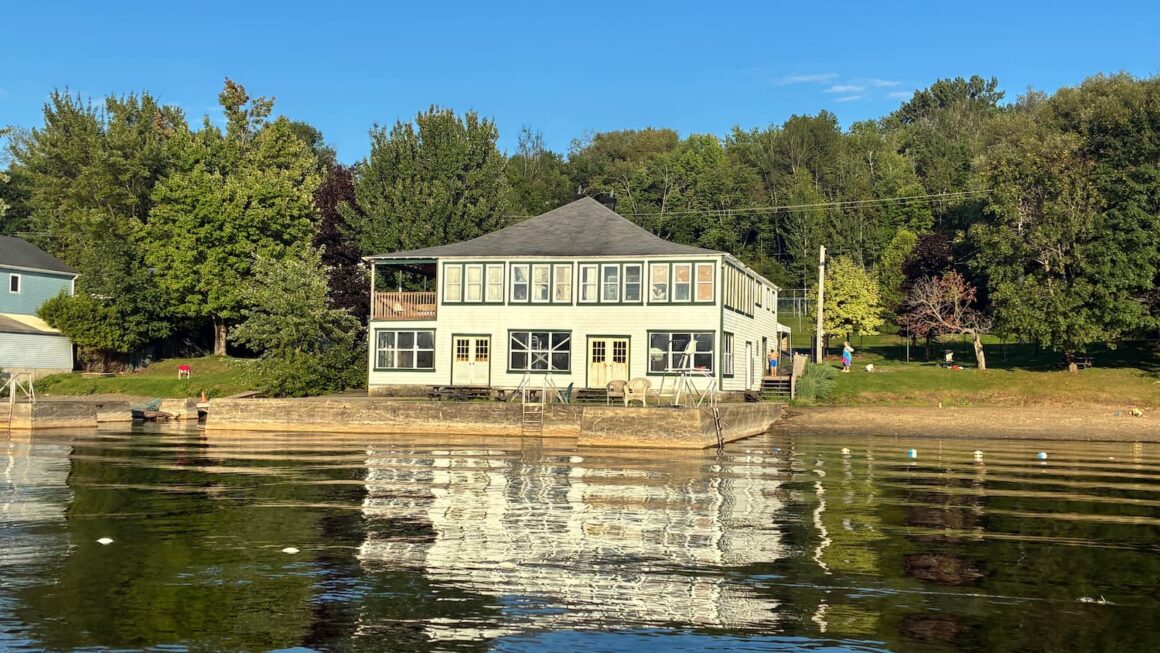
To fully understand the issue, you need to have used North Hatley’s boat ramp and its washing station. It quickly becomes clear that it is difficult—if not impossible—to adequately serve all types of users.
Think, for example, of boaters who go out in the evening: motorboat owners, kayakers, paddleboarders… Many enjoy stargazing on the lake after sunset and want to return late. On warm summer nights, it is particularly pleasant to stay on the water well past nightfall. Therefore, if the attendant leaves at 8:00 p.m., you are no longer able to remove your boat even though the evening is far from over.
To solve this, attendants would need to be available from 6:00 a.m. to 9:00 p.m. However, even with this schedule, not all needs would be met:
- Anglers want to be on the water at sunrise and may return as early as 4:30 a.m. or as late as 10:00 p.m.
- Astronomy enthusiasts may sometimes want to exit the lake after midnight.
In North Hatley, the staffed boat washing station was open from 6:00 a.m. to 8:00 p.m. during the summer. It is a quality service, but clearly insufficient to meet the needs of all users.
A staffed washing station: costly, slow… and incomplete
If we look at the entire season, imagine the cost of staffing a washing station from 6:00 a.m. to 8:00 p.m., seven days a week, from June through late September, even though:
- lake trout fishing season begins in late April;
- bass fishing ends on November 30.
In practice, the service would need to cover anglers beginning in late April, continue throughout the month of May, and extend at least until the end of October.
Another consideration: according to municipal communications, when the lake water is 10°C (50°F) or less, the gate was opened. Does colder water reduce the risk of invasive species spreading?
Cost estimate for a staffed washing station
Scenario: 7 days a week, June 1 to September 15, from 6:00 a.m. to 8:00 p.m.
| Element | Value |
|---|---|
| Total days | 107 |
| Total hours | 1,498 h |
| Wage cost @ $20/h | $29,960 |
Including payroll expenses:
| Employer burden rate | Estimated total |
|---|---|
| +15% | $34,454 |
| +20% | $35,952 |
| +25% | $37,450 |
So, we are looking at a minimum of $35,000 just for June to mid-September.
We do not know the exact revenue generated from washing fees, but it would require a large number of boats, kayaks, and paddleboards to cover even just the attendant’s salary.
Revenue Scenarios
A. 100% motorboats (no kayaks or paddleboards)
≈ 584 boats per season @ $60 each (≈ 5.5 boats/day)
B. 50% boats – 50% kayaks/paddleboards (in revenue, not volume)
≈ 350 boats + 2,800 kayaks/paddleboards
(≈ 3.3 boats/day & 26 kayaks/day)
C. 25% boats – 75% kayaks/paddleboards
≈ 250 boats + 4,000 kayaks/paddleboards
(≈ 2.3 boats/day & 37 kayaks/day)
The cost for users
It’s also clear that some people are uncomfortable with the idea of paying to access a public lake — and that is understandable.
In 2025, the fee to launch a boat was $60 per day (compared to $75 in 2024). That is expensive, even if some argue that “boat owners have the means.” And it must be noted that this is a daily fee, since non-residents are not allowed to purchase the $350 annual permit unless they provide proof of docking. (Reference)
However, the only place to rent a dock in North Hatley is the North Hatley Marina, at about $2,100 + tax, and private dock rentals are prohibited in North Hatley.
Comparison: staffed washing station vs. self-serve system
Below is the order-of-magnitude comparison generated by ChatGPT:
1) Purchase & installation costs
| Cost item | Self-serve station | Staffed station | Notes |
|---|---|---|---|
| Equipment (machine, pump, hoses) | $15,000 – $20,000 | $12,000 – $18,000 | More automation for self-serve |
| Shelter / structure / concrete pad | $8,000 – $12,000 | $8,000 – $10,000 | Similar |
| Plumbing & electrical | $7,000 – $10,000 | $6,000 – $8,000 | Varies |
| Studies / engineering / plans | $3,000 – $5,000 | $3,000 – $5,000 | Similar |
| Total estimate | ≈ $30,000 – $40,000 | ≈ $27,000 – $35,000 | Self-serve slightly higher upfront |
2) Annual operating costs (excluding revenue)
| Annual item | Self-serve | Staffed | Notes |
|---|---|---|---|
| Electricity / water | $800 – $1,500 | $800 – $1,500 | Same |
| Maintenance & repairs | $1,500 – $3,000 | $1,500 – $3,000 | Similar |
| Management / inspections / cleaning | $1,000 – $2,000 | $1,000 – $2,000 | Similar |
| On-site staff | $0 | $38,000 – $45,000 | Major cost |
| Annual total | ≈ $3,000 – $7,000 | ≈ $41,000 – $50,000 | Staff is main driver |
3) Five-year projection
| Category | Self-serve | Staffed |
|---|---|---|
| Initial investment (Year 1) | $30,000 – $40,000 | $27,000 – $35,000 |
| Average annual operating cost | ≈ $5,000/year | ≈ $45,000/year |
| 5-year total estimate | ≈ $55,000 – $65,000 | ≈ $250,000 – $260,000 |
| Portion related to staffing | $0 – minimal | ≈ $200,000 – $225,000 |
| Sensitivity to usage | Low | High |
(Based on approx. $5,000/year self-serve vs. $45,000/year staffed, June–September schedule, 6 a.m.–8 p.m.)
Summary
Both systems require roughly the same initial investment: $30,000 to $40,000.
The major difference, unsurprisingly, is the cost of staffing, which drives the long-term cost far above the initial investment.
And on this point, there is no real miracle solution: whenever long operating hours with on-site personnel are required, the costs increase dramatically.
For this reason, many shoreline municipalities in Quebec have chosen to implement self-serve washing stations.
Photo credit: Bleu Massawippi