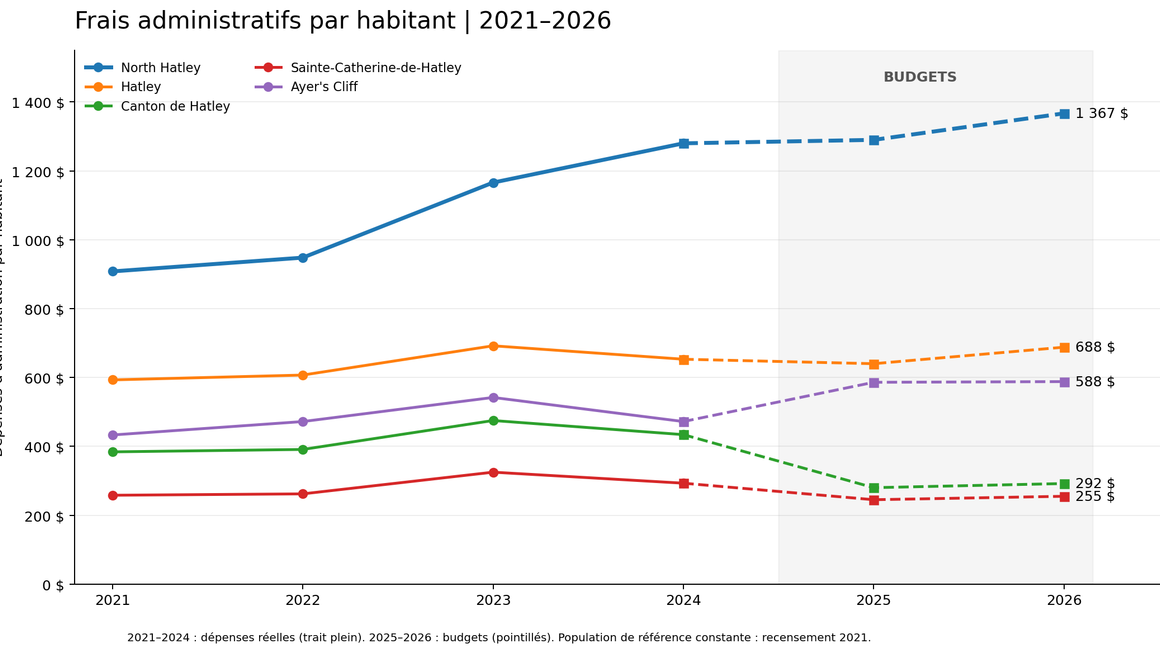
In conversations with citizens, it is often said that property taxes are very high in North Hatley, especially when compared to the Township of Hatley, Sherbrooke, or Magog. In my opinion, these few comparisons are not enough to draw any conclusions.
I therefore extracted the property tax rates for all municipalities (1,037) available at the MAHM for the year 2024, as well as their average residential property assessments (1 dwelling) for 2024. I cross-referenced this data to estimate a typical bill: average residential assessment (1 dwelling) × average residential tax rate (1 dwelling), + fixed costs (water, waste, etc.). I then ranked the municipalities from highest to lowest tax amount.
Everyone is free to repeat the exercise and draw their own conclusions—the method and basis for calculation are the same for all. It is possible that errors may have crept in. The aim is not to criticize, but to understand and position oneself correctly.
Data sets:
Statistical data on property assessment – Table by municipality – 2024
Municipal data – Tax rates for 2024
North Hatley ranks 8th out of 1,037 municipalities.
Average municipal tax = (Average value of a single-family home ÷ 100) × Rate ($/100) + Fixed fees.
For the year 2024, according to data extracted from the MAHM.
| Order | Population | Municipality | Average value for 1 dwelling | Average property taxes | Single or cumulative tax rate | Fixed costs |
| 1 | 20 093 | Westmount | 2 833 881 $ | 17 987 $ | 0,6347% | 0 $ |
| 2 | 7 469 | Hampstead | 2 157 006 $ | 16 926 $ | 0,7847% | 0 $ |
| 3 | 21 775 | Mont-Royal | 2 135 956 $ | 11 116 $ | 0,5204% | 0 $ |
| 4 | 5 250 | Montréal-Ouest | 1 139 499 $ | 10 846 $ | 0,9518% | 0 $ |
| 5 | 37 833 | Côte-Saint-Luc | 1 083 944 $ | 9 379 $ | 0,8653% | 0 $ |
| 6 | 125 | L’Île-Cadieux | 1 895 071 $ | 9 046 $ | 0,4300% | 897 $ |
| 7 | 292 | Estérel | 1 519 538 $ | 8 542 $ | 0,5169% | 688 $ |
| 8 | 691 | North Hatley | 701 218 $ | 8 253 $ | 1,0167% | 1 124 $ |
| 9 | 876 | Saint-Donat | 637 335 $ | 7 357 $ | 0,9800% | 1 111 $ |
| 10 | 2 909 | Stanstead | 759 372 $ | 7 296 $ | 0,8816% | 601 $ |
| 11 | 1 016 | Senneville | 1 470 915 $ | 7 060 $ | 0,4800% | 0 $ |
| 12 | 19 290 | Beaconsfield | 1 140 405 $ | 6 952 $ | 0,6061% | 40 $ |
| 13 | 50 171 | Dollard-des-Ormeaux | 835 779 $ | 6 644 $ | 0,7572% | 315 $ |
| 14 | 9 680 | Lorraine | 737 361 $ | 6 433 $ | 0,8127% | 440 $ |
| 15 | 8 396 | Lac-Beauport | 630 752 $ | 6 346 $ | 0,7834% | 1 405 $ |
| 16 | 19 564 | Kirkland | 991 268 $ | 6 323 $ | 0,6288% | 90 $ |
| 17 | 3 710 | Baie-D’Urfé | 1 289 525 $ | 5 858 $ | 0,4474% | 89 $ |
| 18 | 362 | Sainte-Sabine | 420 901 $ | 5 858 $ | 1,0556% | 1 415 $ |
| 19 | 4 894 | Morin-Heights | 700 479 $ | 5 818 $ | 0,7490% | 571 $ |
| 20 | 17 302 | Saint-Basile-le-Grand | 617 196 $ | 5 786 $ | 0,8228% | 708 $ |
| 21 | 12 001 | Cantley | 629 371 $ | 5 766 $ | 0,7838% | 833 $ |
| 22 | 6 252 | Lac-Brome | 809 288 $ | 5 742 $ | 0,6150% | 765 $ |
| 23 | 9 141 | Otterburn Park | 544 945 $ | 5 719 $ | 0,8946% | 844 $ |
| 24 | 24 097 | Candiac | 827 503 $ | 5 715 $ | 0,6238% | 553 $ |
| 25 | 11 699 | Notre-Dame-de-l’Île-Perrot | 726 248 $ | 5 453 $ | 0,6473% | 752 $ |
| 26 | 3 821 | Saint-Adolphe-d’Howard | 580 384 $ | 5 417 $ | 0,6800% | 1 470 $ |
| 27 | 11 834 | Bromont | 787 189 $ | 5 393 $ | 0,6040% | 638 $ |
| 28 | 22 761 | Saint-Lazare | 750 155 $ | 5 317 $ | 0,6262% | 620 $ |
| 29 | 690 | Saint-Sébastien | 374 244 $ | 5 303 $ | 1,1321% | 1 066 $ |
| 30 | 613 | Murdochville | 125 565 $ | 5 302 $ | 3,4400% | 983 $ |
Table of calculations and ranking of Quebec municipalities
Average property value for a residence (1 dwelling)
For North Hatley in 2024, the average property value of a residence (1 dwelling) is ≈ $701,218.
To do this, I used the MAHM’s 2024 Table of Municipalities:
- MAMH codes used: 300031 (total residential value of 1 dwelling) ÷ 300028 (number of residential units with 1 dwelling).
- Identical result for Standardized and Non-standardized sheets: $187,225,100 ÷ 267 ≈ $701,217.60.
Changes in taxation to service the debt
Admittedly, the amount collected for debt servicing represents a portion of the municipal tax bill for every citizen of North Hatley.
For the year 2024
| Type of building | Average rating ($) | Debt service ratio ($/100 $) | Amount ($) |
|---|---|---|---|
| Average building (all categories) | 535 627$ (ref) | 0,2096% | 1 099,38$ |
| Residential (1 dwelling) – average | 701 218$ (ref) | 0,2096% | 1 469,75$ |
The debt service tax rate fell from 0.3592% in 2021 to 0.2096% in 2025. However, the average property assessment increased by 70.80% over four years. The debt service tax therefore remained the same, falling from $1,102 to $1,099 between 2022 and 2025.
| 2025 | Écart | 2024 | Écart | 2023 | Écart | 2022 | |
| Average property assessment | 524 511 $ | -2,08% | 535 627 $ | 64,09% | 319 639 $ | 4,08% | 307 097 $ |
| Tax rate | 0,2096% | -0,19% | 0,21% | -41,54% | 0,3592% | 0% | 0,3592% |
| Service de la dette moyen | 1 099 $ | -2,26% | 1 125 $ | -2,03% | 1 148 $ | 4,14% | 1 102 $ |
References :
https://northhatley.info/2025/10/22/evolution-taxes-et-valeurs-foncieres-a-north-hatley-2022-2025/
https://northhatley.info/wp-content/uploads/2025/09/NH-Sept-16-Presentation-v3.1.pdf
Difference between debt servicing and general taxation
General tax account: presents a general tax rate used to finance operating expenses: salaries, road maintenance, snow removal, administration, recreation, etc.
Debt service: finances long-term investments that have already been made, such as, to my understanding, the water system in the case of North Hatley.
End of municipal debt in 2031
Debt servicing accounts for approximately $700,000 in annual property taxes. This amount is used to repay the municipality’s long-term debt, in this case, the water system.
The municipal debt (gross) shows a balance at the end of 2024 of $3,981,833. Here is an overview of the remaining years to repay this debt at an interest rate of 5% and a fixed annual repayment of $700,000.
| Year | Opening balance | Interest (5%) | Payment | Repaid Capital | Closing balance |
|---|---|---|---|---|---|
| 2025 | 3 981 833$ | 199 092$ | 700 000$ | 500 908$ | 3 480 925$ |
| 2026 | 3 480 925$ | 174 046$ | 700 000$ | 525 954$ | 2 954 971$ |
| 2027 | 2 954 971$ | 147 749$ | 700 000$ | 552 251$ | 2 402 720$ |
| 2028 | 2 402 720$ | 120 136$ | 700 000$ | 579 864$ | 1 822 856$ |
| 2029 | 1 822 856$ | 91 143$ | 700 000$ | 608 857$ | 1 213 999$ |
| 2030 | 1 213 999$ | 60 700$ | 700 000$ | 639 300$ | 574 699$ |
| 2031 | 574 699$ | 28 735 | 700 000$ | 671 265$ | ≈ 0 |
There really is light at the end of the tunnel, provided that the debt is repaid consistently each year. It is even possible to accelerate the repayment schedule, but this depends on two levers: increasing revenue or reducing/controlling expenditure. The second is generally the most controllable in the short term; the first involves more financial risk and benefits spread over several years.
In the meantime, other debts could be added, especially to maintain or rebuild our current infrastructure.
With that in mind, happy thinking!