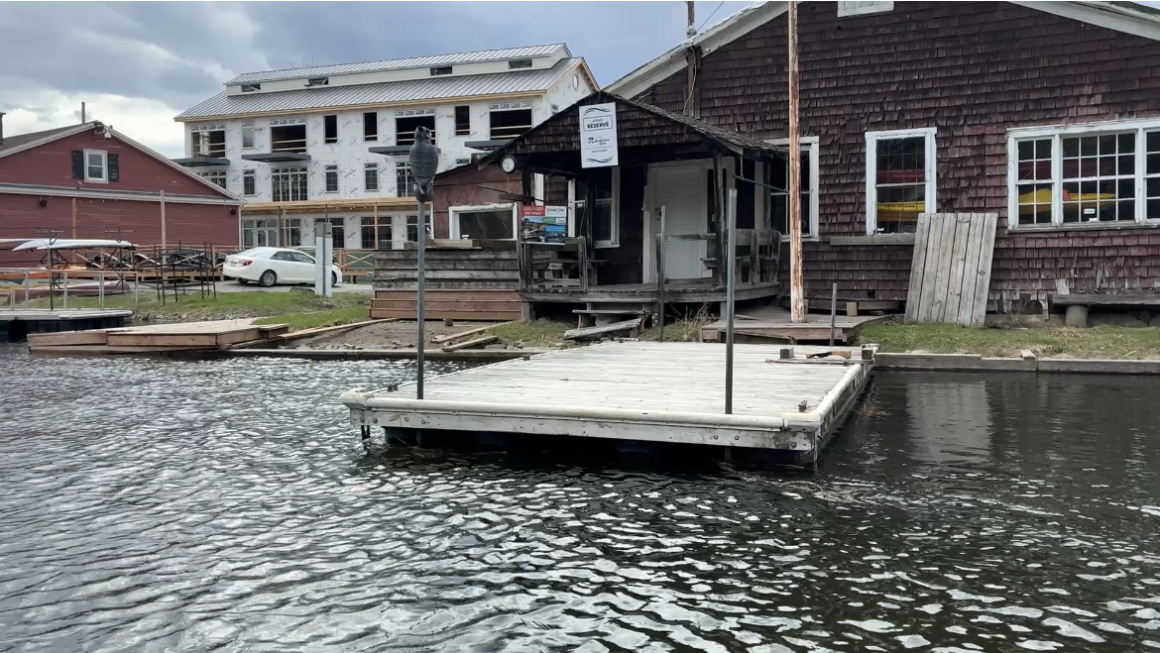
Following the recently published demolition notice, several residents seem to be questioning the real environmental impact of tearing down buildings like the one at the beach. After looking into it, I discovered that an average 1,000- to 2,000-square-foot house typically represents 30 to 100 tons of materials to manage. And depending on how carefully the contractor sorts and recycles on site, no more than about 30% of those materials will actually be recycled.
In practical terms, if a building generates 100 tons of materials, around 70 tons end up directly in the landfill. In the case of the Pleasant View beach building, it’s easy to imagine two to three times that amount.
Of course, there are situations where demolition truly is the only realistic option. That is likely what happened with some of the recent demolitions in North Hatley. The former Picalily restaurant is probably a good example.
Demolition vs. renovation: think in decades, not months
We also need to consider the long-term efficiency of a new construction compared to an older building. A new house can indeed be much more energy-efficient: better insulation, tighter building envelope, modern windows, more efficient mechanical systems, and so on.
But we must look at the overall footprint over 30 to 50 years (or more). From what I understand, demolishing and rebuilding often emits, in a single blow, the equivalent of several decades of heating an existing home.
In other words, you don’t need complex equations to see that the most ecological building is the one that already exists—provided we improve it intelligently. But of course, that isn’t always possible.
When demolition can be environmentally justifiable
There are situations where demolition does make sense environmentally, for example:
- Dangerous or irreparable structure
(major foundation problems, structural failure, severe hidden defects, etc.) - Significant contamination
(widespread mold, chemical contamination, hazardous materials that are extremely difficult to manage otherwise) - Building that is nearly impossible to make energy-efficient
(very poor orientation, dysfunctional layout, major thermal bridges everywhere, technical impossibility of correcting the issues without disproportionate costs or impacts)
In these cases, we can calculate the so-called “carbon payback period”: the time needed for the new building to “repay” its construction emissions through future energy savings. This period can easily be 20, 30 years or more.
For my part, if it can be clearly demonstrated that the building is no longer realistically renovatable and that long-term energy gains are real and measurable, demolition can be justified.
The role of the CCUP: demolish… or renovate?
What concerns me is that demolition sometimes seems to be chosen a bit too quickly, almost by reflex, without a thorough analysis—especially when the process is not tightly controlled. This isn’t meant as criticism; I would probably fall into the same reflex myself.
In my view, this is exactly where the CCUP should play a central role:
to issue a well-reasoned opinion on the key question:
Should this building truly be demolished, or should renovation be prioritized?
This is a critical mandate, both from a heritage perspective and an environmental one, and it deserves open discussion. At the same time, as a property owner, it can understandably be very frustrating to feel like you’re losing control over your own building.
With that, food for thought!